Investor brief · June 2026
The contribution operating system for grassroots community.
Every grassroots community runs on the unpaid work of a handful of people who eventually burn out. Stride & Rise makes that work visible, recognized, and rewarded — starting with run clubs.
Live in production at strideandrise.com. Flagship club in Austin. Three outside clubs actively onboarding from the waitlist.
Live numbers from the production database. Updated every 5 minutes.
Why now
Grassroots community is back. The tooling isn’t.
Running participation has hit record highs post-2023. Run clubs in major US cities are growing 30–80% year over year. Civic membership has been in long decline since Bowling Alone — grassroots fitness clubs are one of the few in-person communities still growing in its place.
And yet: every one of these clubs runs on a group chat and a spreadsheet. There is no source of truth for who showed up, who hosted, who brought a friend, who took the recap photos. Recognition is informal, contribution is invisible, and the same three people burn out.
Stride & Rise is the contribution layer those clubs need. Every action a member takes is logged, recognized, and converted into ownership share of the club — a contribution-weighted % share (recognition, not legal equity). The leaderboard makes the invisible work visible. The tier system gives the work tangible rewards.
Market
$1.5B TAM, bottoms-up.
Run clubs are the wedge — a $85M bottoms-up TAM (3M global run clubs × 10% paid conversion × $23/mo blended ARPU). The same contribution loop extends to fitness clubs ($300M) and the broader category of recurring in-person groups — book clubs, makerspaces, cycling clubs, neighborhood groups — we collectively call culture clubs ($1.1B).
Three tailwinds compound the opportunity: loneliness is now a consumer-grade problem (30% of US adults feel lonely weekly), Gen Z has made fitness a top-tier life priority (56% rate it “very high”, vs. 40% of US consumers overall), and digital-native communities are moving offline (73% of 18–35-year-olds plan to attend live events in the next 6 months; 95% want to explore online interests through in-person events).
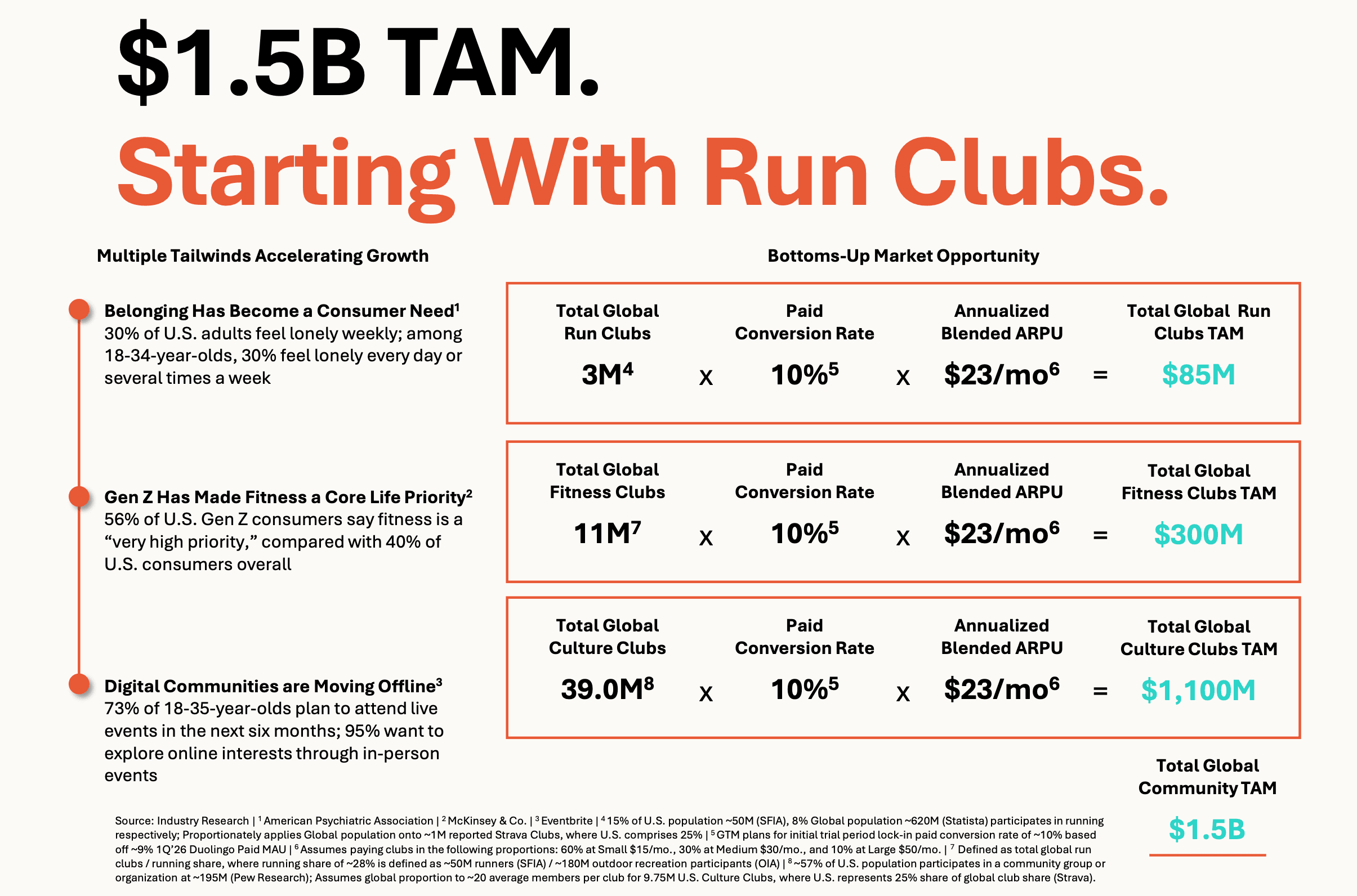
Sources: Industry Research, American Psychiatric Association, McKinsey & Co., Eventbrite, Strava Clubs, Statista, Pew Research, IHRSA.
Product
Multi-tenant, mobile-first, in production today.
Every club gets its own page at strideandrise.com/c/[slug]: member directory, event calendar, check-in flow, contribution log, ownership ledger, and a gated perks system.
The core member loop is one tap: show up → check in → log a contribution → climb the leaderboard → unlock the next tier.The founder loop is one dashboard: events, members, broadcasts, contribution types, and tier rewards.
Stack: Next.js 15, React 19, TypeScript, Supabase Postgres with row-level security, Resend for transactional and broadcast email, Vercel for hosting. Multi-tenant by design — every query is scoped by community_id and enforced by RLS policies and tenant-integrity triggers.
Traction
From 19 in the rain to a live platform in 15 months.
Milestones
Business model
Prove retention first. Charge second.
Waitlist-only access for hand-picked clubs while we prove retention and weekly activity. The goal of Phase 1 is product-market evidence, not revenue. Pricing model and timing TBD after first-cohort data.
Once retention is proven, introduce a per-club monthly subscription. Founders pay because the platform is replacing a job they were doing for free — recognition, attendance, contribution tracking, perks.
Vision & moat
A new category: community contribution.
The defensible asset is the contribution data. Every logged contribution compounds the network: the recommendation engine for new clubs gets smarter, brand-matching for perks gets cleaner, and the ledger itself becomes a credential — a verifiable record of who actually built the things you participate in.
Closest analogs: GitHub for code contribution, Strava for athletic activity. Stride & Rise is the equivalent for community contribution — and nobody else is building it.
Team
Three founders. Six years of trust. No friction.
Built together since 2020 through college at Northeastern University. High-trust, fast-moving, no friction. One who lives the mission, one who knows how platforms scale, and one who makes community feel like home.

Software engineer at Visa Secure on 3D Secure auth infrastructure; prior SWE at Asics. Built strideandrise.com on Next.js + Supabase. Grew the Austin Run Club from 19 to 221 members with $0. Content creator and community builder in one.
Consumer Technology Investment Banking at Wells Fargo. Transactions include Bending Spoons’ acquisition of AOL & Vimeo, and supporting several ongoing Consumer AI IPOs. Past roles at a Series B startup, startup investment bank, and private equity.
Product Designer at Tank Design. Led end-to-end design for Princess Cruises, Fidelity, Boston Globe, and Hilton. High-velocity shipping in scalable UI systems, illustration libraries, motion graphics, and design systems.
Where we are
Pre-seed. Early conversations only.
The goal of Phase 1 is evidence — retention, weekly activity, and the three clubs now onboarding from the waitlist as the first outside cohort. We’d rather shape a round around real data than around assumptions, so size and structure will follow the cohort, not the other way around.
Most useful to talk to: investors and operators who’ve built community-led products, IRL networks, marketplaces, or lifestyle brands — people with real conviction in grassroots community as a category. If that’s you, reach out below.
Contact
clayanbusy@gmail.com · Clayton Yan, Technical Founder & CEO
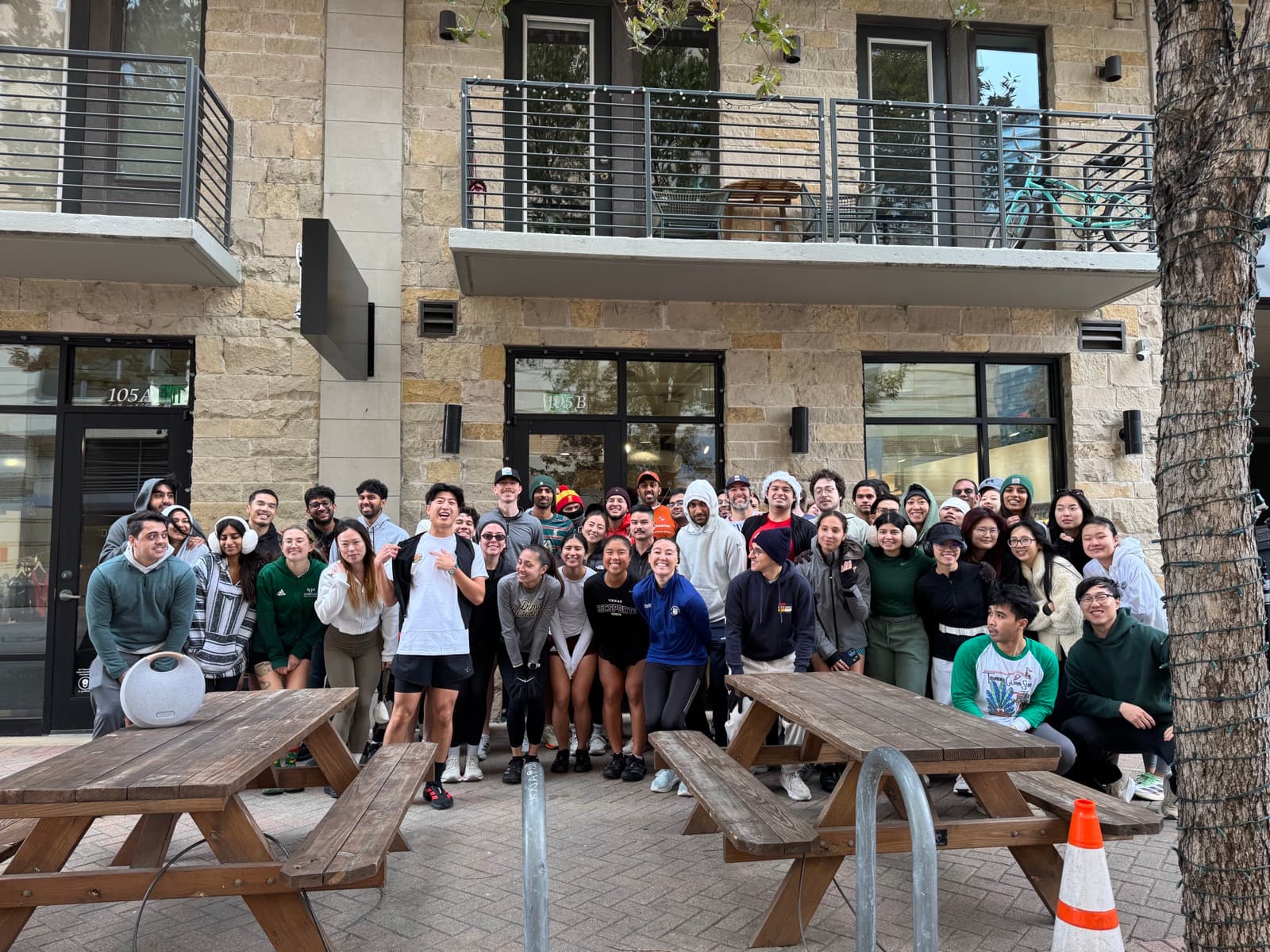
Austin, one year of Stride & Rise.